
 Product
 Brand
Brand
 Articles
 Tools
Tools
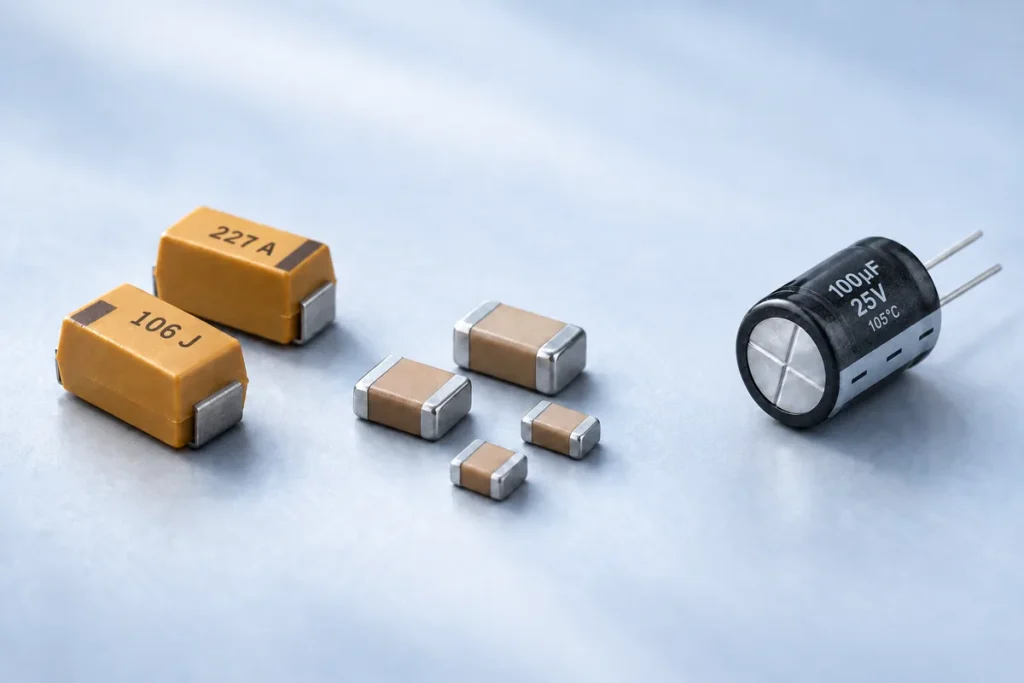
Choosing the right capacitor for a circuit usually means comparing three popular families: tantalum, multilayer ceramic (MLCC), and aluminum electrolytic. Each technology has a different strength, and the best choice depends on what the capacitor is being asked to do.
Tantalum capacitors are the high-density champions. Their porous sintered anode gives them a large capacitance in a small case, with excellent stability over temperature. They have a self-healing dielectric in the sense that a local dielectric failure can be isolated by the cathode material in many cases, but manganese dioxide versions still require careful derating and can fail short under sustained stress. Conductive polymer tantalum parts behave differently, with lower ESR and a much softer failure mode.
MLCCs are the king of high-frequency decoupling. They have very low ESR, excellent high-frequency behavior, and a wide voltage range, but their capacitance is strongly voltage-dependent: Class 2 dielectric ceramics can lose a large fraction of their nominal capacitance under DC bias. They are also sensitive to mechanical stress and can crack when a board is flexed, which is why some applications use soft-termination parts.
Aluminum electrolytic capacitors offer very high capacitance at low cost and are usually the only practical choice for bulk energy storage and smoothing at the power input of a converter. Their downside is much larger physical size, higher ESR than tantalum or MLCC at high frequency, limited lifetime due to electrolyte drying, and worse behavior at very low temperatures.
A practical way to decide is to ask what the capacitor is filtering or buffering. For fast digital switching and tight decoupling, MLCC is normally the first choice, supported by a tantalum or aluminum capacitor for bulk energy. For a small rail where board space is tight and the temperature range is wide, tantalum performs well. For high-voltage input bulk storage, aluminum electrolytic remains the classic solution. For demanding power designs, a polymer tantalum can be an excellent compromise between size, ESR and reliability.
Other selection criteria include derating policy, ripple current, ESR target, maximum temperature, operating lifetime, voltage transients, and counterfeit risk. Many companies standardize on a small number of preferred capacitor families so that sourcing, qualification, and replacement are predictable. A good datasheet review should include the case size, capacitance tolerance, DC leakage, ESR at 100 kHz, ripple current limits, and the manufacturer’s recommended derating conditions.
In short: use MLCC for speed, tantalum for density and stability, and aluminum electrolytic for bulk energy. The best designs combine all three in the right places.
Need tantalum capacitors for a production build?
Send us your part numbers, quantities and target date through our RFQ form, or contact us and we will come back with availability and lead time for the exact part. If you are still selecting, our tantalum capacitor listing has the case sizes and ratings we carry.